

24/7 Electrician
Window Air Conditioners in Older Homes: Outlets and Circuits
What a window air conditioner needs in an older Cooper City home: the nameplate, dedicated circuits, two-prong and loose outlets, and why extension cords fail.
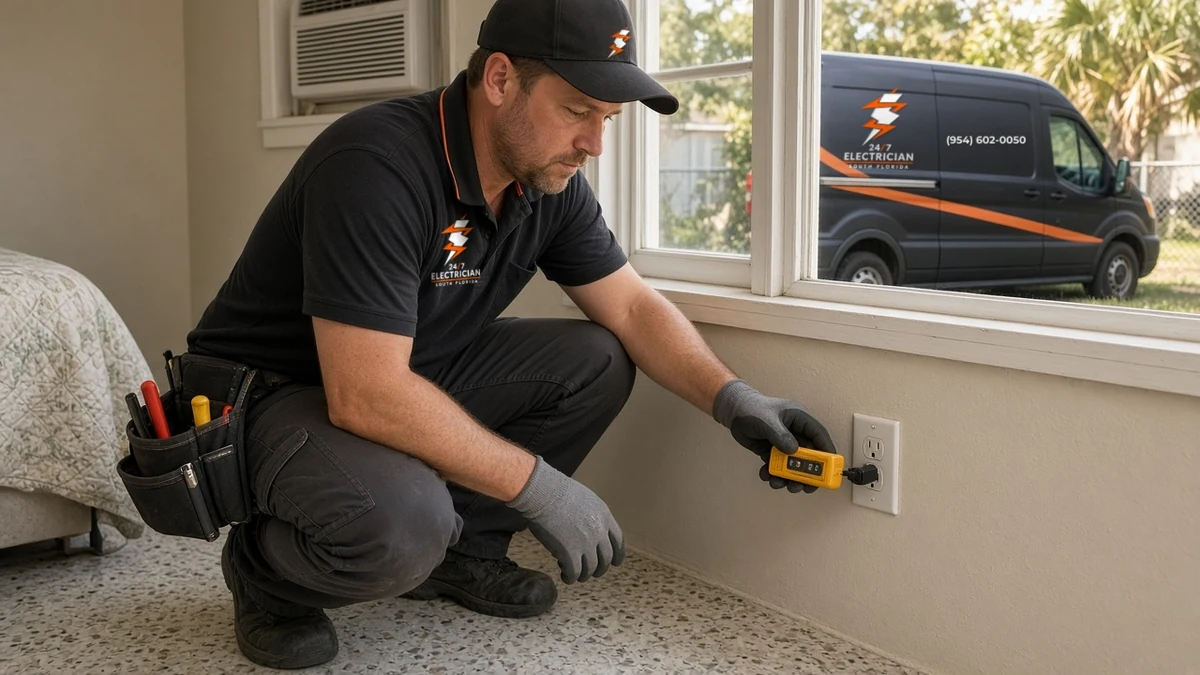
Window air conditioners are still a normal sight in Cooper City: in an older bedroom, in a Florida room, in a garage workshop, or in an addition that was never tied into a central system. They are straightforward machines until the electrical side is wrong. A unit that is too large for the circuit, a loose outlet, a two-prong receptacle, or an extension cord under a window can turn a hot-afternoon comfort item into a tripped breaker, a warm plug, or worse.
This guide explains, from an electrician's point of view, how to read the unit's label, when a dedicated circuit is in order, what to do about older outlets, why extension cords are a bad idea, and which warning signs mean you should stop and have the circuit checked. It is general guidance. It is not a sizing guide for air conditioning, and it is not an HVAC recommendation. 24/7 Electrician can check and improve the electrical side in Cooper City. The cooling equipment itself belongs to the unit's manufacturer instructions and, when you need a different kind of system, to a licensed air conditioning contractor.
If a plug, a cord, or an outlet is hot, discolored, or smells like burning plastic, unplug the unit if you can do so safely, or shut the breaker off, and have it looked at. See what to do about a burning smell from an outlet.
Reading the unit's label
Before you plug a window unit into an older house, read the nameplate. It is usually on the side or the back of the chassis, and the same numbers appear in the manual.
Look for:
- Volts. Most household window units are 120 volts. Some larger units use 240 volts and a different receptacle. Do not force a plug into an outlet it was not made for, and do not change a plug to "make it fit."
- Amps or watts. This is the draw. It tells you, in combination with what else is on the circuit, whether a general-purpose outlet is a poor match.
- The plug type. A three-prong plug needs a three-prong, properly grounded receptacle (or a correctly done upgrade). A 240 volt unit will have a different plug shape.
- Manufacturer instructions about cords and circuits. Many manuals say, in plain language, to plug the unit directly into a wall outlet, not into an extension cord or a multi-plug strip, and some ask for a dedicated circuit.
Write the numbers down, or take a photo of the nameplate, before you call anyone. "It is a window AC" is less useful than "it is a 120 volt unit, and here is the amp draw on the label."
If you have not bought the unit yet, get the electrical requirements first, then look at the room and the outlet, then buy. The other order is how people end up with a unit they cannot use safely on the circuit they have.
Dedicated circuits
A dedicated circuit is a circuit that serves one appliance or one receptacle, so the air conditioner does not share a breaker with a TV, a space heater, a hair dryer, a refrigerator, or a handful of bedroom outlets.
Why it matters. Window units often run for hours. They also have a higher start-up draw when the compressor kicks in. A circuit that was fine with a lamp and a fan may trip when the compressor starts, or it may run warm for a long time. A dedicated circuit keeps the unit on its own breaker and keeps the lights in the room from being part of that problem.
Not every small unit needs a new circuit. A modest unit on a lightly loaded, correctly wired circuit, with a good three-prong outlet, may be acceptable. A larger unit, a long run of older wire, or a bedroom circuit that already has a lot on it is a different story. An electrician can tell you which one you have by looking at the panel, the outlet, and the nameplate.
Sharing is the common problem in older Cooper City homes. One circuit may serve two bedrooms and a hallway, or a Florida room and a porch. You will not see that from the outlet alone. A breaker that trips when the unit starts, or lights that dim at the same moment, are clues.
If you are already adding an outlet for a window unit, it is often the right moment to give that outlet its own circuit, rather than to tap the nearest box and hope.
If a breaker keeps tripping, stop resetting it and have the circuit checked. Our article on a breaker that keeps tripping covers the general habit.
Two prong and loose outlets
Older homes still have two-prong outlets, and they still have outlets that have loosened in the box after years of plugs going in and out.
A two-prong outlet is not a good match for a modern window unit that expects a grounded, three-prong receptacle. Do not use a cheater adapter as a permanent plan, and do not break the third prong off the plug. The right path is a proper outlet upgrade, which may also involve the grounding or wiring method in the wall. Our pages on two-prong outlets and two-prong outlets in older Hollywood houses explain the idea. The same approach applies in Cooper City.
A loose outlet that lets the plug wiggle can heat up, especially with a unit that runs for hours. If the plug feels loose, if the outlet moves in the wall, or if the face is cracked, stop using it for the air conditioner and have the receptacle (and the box behind it) looked at.
GFCI protection may be part of the conversation, depending on the location: a garage, a patio-adjacent room, or another area that calls for it. See where GFCI outlets are required for the general idea. If a GFCI trips when the unit starts, do not keep resetting it without a check. Sometimes the unit has a problem. Sometimes the circuit or the GFCI does.
Painted-over outlets, rusted boxes, and receptacles with bent slots belong in the same "do not use this for a heavy, long-running appliance" category. A window unit is not the appliance to plug in "just for the weekend" on a damaged device.
No extension cords
This one is worth its own section because it is the most common shortcut, and it is a bad one.
Plug a window air conditioner directly into a wall outlet that is in good condition and is a match for the unit, unless the manufacturer says otherwise and a listed accessory is part of a designed setup. A regular extension cord, a household power strip, or a light-duty cord run across a floor is not that setup.
Why cords are a problem here:
- The unit runs for hours, and the cord and the connections can heat up
- A window is a pinch point. Cords get crushed, rained on, or pulled
- People walk on the cord, or a chair rolls over it
- A long, thin cord is a voltage drop and a heat source, not a circuit
If the outlet is on the wrong wall, the right answer is a new outlet in the right place, on an appropriate circuit, not a longer cord. If you already have a cord in place, stop using it for the air conditioner and have the outlet moved or added.
A "heavy duty" orange cord from a garage shelf does not change this advice for a window unit that will run all afternoon, every afternoon.
Warning signs
Stop and have the electrical side checked if you notice:
- A plug, a cord, or an outlet that is warm or hot to the touch
- Discoloration, melted plastic, or a burning smell
- A breaker that trips when the unit starts or after it has been running
- Lights that dim each time the compressor kicks in
- A buzzing outlet or switch
- A GFCI that will not reset, or that trips repeatedly
- A loose plug that arcs or sparks when it is moved
- A unit that will only run when something else in the house is turned off
Unplug the unit, or shut the breaker off, if any of the heat or burning signs are present and you can do so safely. Then call. Do not keep running the unit "because it still cools."
A window unit that works but trips a breaker only late in the afternoon may be sharing a circuit with other afternoon loads, or it may be telling you that the circuit is at its limit in the heat. Either way, it is information, not a personality quirk of the house.
Talk to an Electrician
We answer the phone fast
From panels and wiring to lighting, generators, EV chargers and three phase power, we cover South Florida homes and businesses, including emergency repairs. Share the problem and we map out the repair.
Call (954) 602-0050When a mini split makes more sense
Some rooms, especially additions, garages, and older bedrooms with a weak window and a weak circuit, are a poor long-term home for a large window unit. A mini split (a ductless system) can be a better cooling plan in those cases, with a cleaner look and a different electrical need.
That decision is first an air conditioning decision. Talk with a licensed HVAC contractor about whether a mini split fits the room, the wall, and the use. If you go that way, an electrician can work on the electrical portion: a correctly sized, dedicated circuit, a disconnect where it belongs, and a clean path for the wiring. Those details should be coordinated, not added after the indoor unit is already on the wall.
A mini split is not automatically necessary. A modest window unit, on a correct outlet and a correct circuit, is still a reasonable solution in many older rooms. The point of this section is to stop you from forcing a large window unit onto a tired circuit when a different system, planned with both trades, would be cleaner.
24/7 Electrician does the electrical work, not the refrigerant work. We will not sell you a cooling system in this article. We will tell you what the circuit can safely support.
Cooper City notes
Cooper City has a mix of older houses, additions, and rooms that were enclosed later. Window units show up in those later spaces because central air was never extended, or because one room runs warmer than the rest of the house.
A few local patterns:
- A Florida room or an enclosed porch often has a short, older circuit and a long sun exposure. The unit's draw and the outlet's condition both need a look.
- Garages and workshops get window units in the hot months, sometimes on a garage circuit that already has tools and a refrigerator. That combination trips breakers.
- After a storm or a long outage, people plug units in quickly. That is the moment to look at the outlet and the cord, not to improvise.
- If a room has only a two-prong outlet, plan the upgrade before the first very hot afternoon, not during it.
When you call 24/7 Electrician at (954) 602-0050, tell us you are in Cooper City, the room the unit is in, and what is on the nameplate if you have it. Mention any warmth, trip, or dimming. That description is enough to start a useful visit.
What to have ready for a visit
A short list makes the visit faster and keeps everyone from guessing at the unit.
- A photo of the nameplate, including volts and amps
- A photo of the outlet, including whether it is two-prong or loose
- A photo of the breaker that trips, if you can identify it, without removing the panel cover
- A note about what else is on in the room or on the same area of the house when the problem happens
- The room type: bedroom, Florida room, garage, or addition
You do not need to take the unit out of the window before we arrive, unless it is unsafe where it is. If the unit is heavy or awkward, say so, so the visit can be planned around a safe look at the outlet and the circuit rather than a wrestling match with the chassis.
If you are buying a unit this week, you can also call before you buy, with the nameplate of the model you are considering. It is easier to choose a unit that matches a correct circuit than to return a unit that does not.
Frequently asked questions
Can I use a surge protector or a power strip with a window AC?
Do not use a household power strip as a substitute for a wall outlet. If a manufacturer lists a specific accessory, follow that document. In ordinary cases, the unit should go directly into a proper wall receptacle.
The unit came with a short cord, and the outlet is far from the window. Now what?
Have an outlet added in the right place, on an appropriate circuit. Do not lengthen the setup with an extension cord.
Will a new outlet alone solve a tripping breaker?
Not if the new outlet is still on the same overloaded circuit. The visit should include a look at the panel and at what else that breaker feeds.
Is a 240 volt window unit something you can wire?
Those units need the correct circuit and the correct receptacle. Tell us the nameplate details. Do not adapt a 120 volt outlet to accept a 240 volt plug.
The window itself is loose or leaks. Is that electrical?
No. The window, the support bracket, and the seal are a different job. They still matter, because a poorly supported unit is hard on the cord and the outlet as well as on the window. Get the unit supported correctly, and get the electrical side correct, rather than fixing only one.
The house has central air, and I still use a window unit in one room. Is that unusual?
It is common in a room that sits over a garage, faces the afternoon sun, or was added later. The electrical questions are the same: the outlet and the circuit have to match the unit, even if the rest of the house is cooled another way.
Can you work on the window bracket or the seal too?
That is usually a different trade, or a handyman or carpenter job. We will tell you if the unit's support is creating a problem for the cord or the outlet, and we will stay on the electrical work.
Need the circuit checked for a window AC in Cooper City?
Call 24/7 Electrician at (954) 602-0050. Tell us the unit's nameplate information, what the outlet looks like, and what you are seeing: trips, warmth, dimming, or a two-prong receptacle. We will tell you whether a new outlet, a dedicated circuit, or another repair is the right next step.
Related pages: Cooper City electrician, Two-prong outlets in older houses, Two-prong outlets and grounding upgrades, Breaker keeps tripping, GFCI outlet requirements, Burning smell from an outlet.
Request Service
Tell us what is happening and we will take it from there
Use this form to give the office the full picture in one step: what is happening, the property location, entry details and the time you need help. Whoever calls you back has read it first.
If the power is out or something smells like it is burning, do not type. Call (954) 602-0050. We answer the phone fast.
Where We Work
36 cities across three counties
Every city has its own page for planned work, and its own page for after hours. Please choose the name of your city, or tap Emergency for urgent dispatch.
Broward County
- Coconut CreekEmergency
- Cooper CityEmergency
- Coral SpringsEmergency
- Dania BeachEmergency
- DavieEmergency
- Deerfield BeachEmergency
- Fort LauderdaleEmergency
- Hallandale BeachEmergency
- Hillsboro BeachEmergency
- HollywoodEmergency
- Lauderdale-By-The-SeaEmergency
- Lauderdale LakesEmergency
- LauderhillEmergency
- Lighthouse PointEmergency
- MargateEmergency
- MiramarEmergency
- North LauderdaleEmergency
- Oakland ParkEmergency
- ParklandEmergency
- Pembroke ParkEmergency
- Pembroke PinesEmergency
- PlantationEmergency
- Pompano BeachEmergency
- Southwest RanchesEmergency
- SunriseEmergency
- TamaracEmergency
- West ParkEmergency
- WestonEmergency
- Wilton ManorsEmergency