24/7 Electrician
Why Backfeeding a Generator Into Your Home Is Dangerous
Plugging a generator into a wall outlet sounds like a shortcut, but backfeeding can injure line workers, start fires and destroy equipment. Here is why.
During a long outage, someone in the neighborhood always says it: just run a cord from the generator into an outlet and the whole house will come back to life. It sounds sensible. The house is wired, the generator makes electricity, and an extension cord can connect the two. The logic is simple, and the consequences are not.
The practice is called backfeeding, and it ranks among the most dangerous mistakes a homeowner can make during a power outage. This article explains what backfeeding is, why it causes harm, what the warning signs look like, and what safe alternatives exist. It is written to inform, not to frighten, because understanding the reason behind a rule is what makes people follow it.
What backfeeding actually means
Your home is designed to receive electricity from the utility and distribute it through the panel to the circuits. Power flows in one direction: from the street, through the meter and the main breaker, and out to the outlets and lights.
Backfeeding means pushing power into the house wiring from the wrong end. Instead of the utility supplying the panel, a generator supplies it, through an outlet, an improvised cord or some other unapproved connection. The electricity then travels backward through the wiring, including through the main service equipment, and may reach the lines outside.
Wiring is not designed for this. The protective devices, the grounding arrangement and the assumptions about where power comes from all rely on the standard one-way flow. When that flow reverses without proper equipment, every safety feature in the system is bypassed.
The danger to utility workers and neighbors
The most serious consequence of backfeeding is not at your house. It happens on the street. When a generator is connected to a home improperly, the electricity can travel out through the meter, onto the service wires and into the transformer that serves your block.
A transformer works in both directions. If it receives low-voltage power from your generator, it can raise it to a dangerously high voltage on the lines that crews are working on. A line that workers believe is dead, because the utility has shut it off, can become live again without any warning.
This risk affects more than the crew. Neighbors who have not lost power can be exposed to abnormal conditions, and anyone near a downed line may be in danger. It is a major reason utilities, fire departments and safety agencies repeat the same message each storm season.
It is also why backfeeding is treated as a serious matter in its own right. Beyond the human cost, a person who causes it can face liability if someone is hurt.
What utility crews face after a storm
After a hurricane or severe storm, crews work for long hours in difficult conditions, often in the dark and the rain, repairing lines that came down or were damaged. Their safety procedures assume that a line they have isolated and tested stays dead. They also ground the lines they are working on. Backfeed power defeats those assumptions, because a source that nobody on the crew knows about is feeding the wires.
Trained line workers have protective equipment, but no equipment can protect against a hazard that is not expected. That is why safety agencies speak so firmly about it, and why homeowners who understand the issue tend to take it seriously.
The effect can also reach your own street. A backfed transformer can produce abnormal voltage that damages the appliances of neighbors who thought they were safely waiting for power to return.
The danger inside your own home
Even if no one outside is harmed, backfeeding creates hazards inside the house. The wiring and the panel are built to carry specific amounts of current on specific circuits, protected by breakers sized for those conductors. Feeding power in through a single outlet puts a large load onto one branch circuit and its wire, which was never meant to carry it.
- Overloaded wire. A branch circuit wire can overheat when power flows through it from the wrong direction at high current, because the breaker may not protect against the way it is being used.
- Energized panel and circuits. Parts of the panel that should be dead can be live, so anyone who opens the panel or touches a circuit believing it is off may be shocked.
- No protection from the utility returning. If utility power comes back while the generator is still feeding the house, the two sources can collide, causing a violent surge, damage to the generator and appliances, and possibly a fire.
The chance of fire is real, because the part of the wire that heats up is inside a wall, out of sight, and nothing warns you until it is too late.
Consider also what happens when utility power returns. Restoration is rarely announced. Lines are re-energized in sections, and your house may receive power at any time of day or night. If your generator is still connected to the wiring when that happens, two power sources meet. They are almost never perfectly in step, so the result is a sudden surge of current that can destroy the generator, damage appliances and electronics, trip breakers or start a fire at the point of connection.
Generators are also not built to be driven backward. The windings and electronics inside can be wrecked by a utility feed, which is an expensive way to discover why transfer equipment exists.
The male-to-male cord and other improvised connections
A cord with a plug on both ends is sometimes called a double-ended cord, and it is a known hazard. One end goes into a generator and the other into a wall outlet. The exposed prongs of the end that is not yet plugged in can be live. Anyone, including a child, who touches them can be seriously hurt.
Other improvised connections are no better. Connecting wires directly to the panel, modifying the main breaker, or using adapters that let a generator plug into a dryer outlet or an air conditioning receptacle all bypass the safeguards that were designed into the system. They may seem to work, and that is part of the danger. A connection that powers the lights tonight can start a fire tomorrow.
These shortcuts are not an area for do-it-yourself ingenuity. Our guide on when DIY electrical work should stop explains why some jobs belong to professionals every time.
Another false comfort is the belief that a connection is fine because it has worked before. Electrical hazards are about probability and consequences, not about last time. A cord and outlet that powered a house safely for one night did so because several things happened not to go wrong. Wiring that is repeatedly overloaded may also be quietly weakening: insulation can darken, connections can loosen, and the damage appears later.
Insurance and legal consequences are worth knowing about as well. An unapproved connection may raise questions with an insurer if a fire follows, and a homeowner can be held responsible when a worker or neighbor is hurt. Most people never think about this until something goes wrong, which is why it is better to think about it now.
Why the main breaker alone does not make it safe
A common belief is that switching the main breaker off before connecting the generator makes backfeeding safe. It is true that opening the main disconnects the house from the utility, but it does not turn an improvised connection into a safe one.
Relying on a person to remember to turn off the main every time, in the dark, during a storm, is a fragile plan. If the main is left on, or someone turns it on by mistake, or utility power returns unexpectedly, the consequences are the ones described above. A proper transfer device makes that mistake physically impossible, so the safety does not depend on anyone's memory.
Even with the main off, there are other issues: overloaded branch circuits, a poorly grounded generator, the wrong connection type, and a plug that may be live. The professional solutions below are designed to address every one of them together.
Safe ways to power a house from a generator
The good news is that safe connections exist, and they are standard practice for electricians. There are three main approaches.
- Plug appliances directly into the generator. Use heavy-duty outdoor cords, keep everything separate from the house wiring, and power only what you need. This is the simplest and a safe option for small needs.
- A manual transfer switch or interlock. A qualified electrician installs a device that physically prevents the generator and the utility from feeding the house at the same time. A generator inlet outside the home allows a proper cord to be connected.
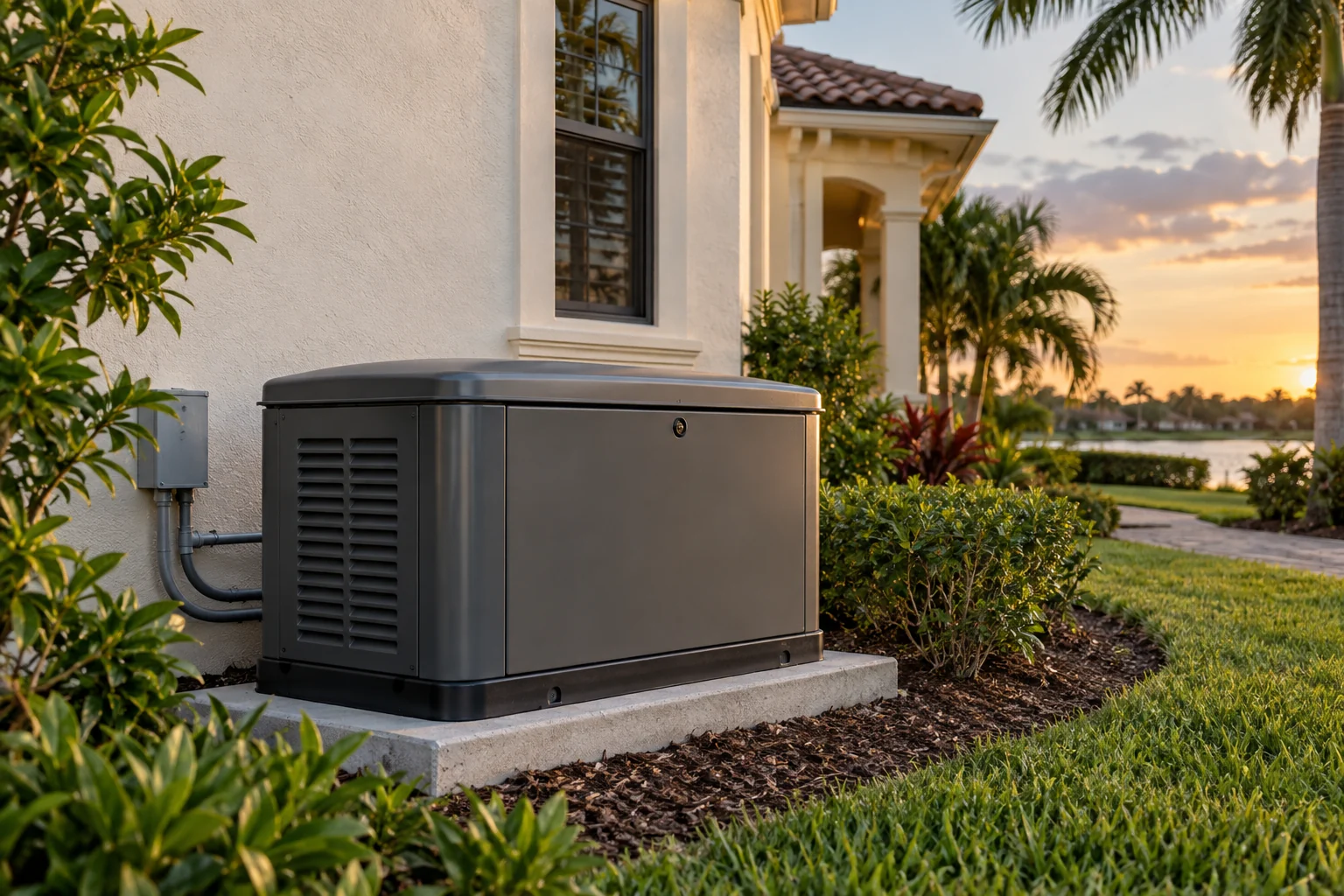
- An automatic transfer switch with a standby generator. The system senses the loss of utility power, starts the generator, and transfers the load automatically, then switches back when power returns.
Each option has a different cost, convenience and capacity. Our generator transfer switch installation article describes the equipment in more detail, and the automatic transfer switch page explains the automatic approach.
How to choose between the options
The right choice depends on how you live. A household that only needs a refrigerator, a few lights and a fan is well served by direct cords from the generator. A household that wants to run well pumps, selected circuits or part of the air conditioning during a multi-day outage is better served by a transfer switch or an interlock and inlet. A household that wants everything to work without anyone going outside in a storm will usually look at a standby generator with an automatic transfer switch.
Think about who will be at home. If you travel, or if elderly relatives live in the house, automatic operation has real value. If you are comfortable running a portable unit and have the storage space, a manual setup can be a sensible middle path.
Our generator installation page explains how these systems are planned, and it is worth reading before you decide. The right installer will ask about your loads, your panel and your priorities, and will explain the options in plain terms.
What a transfer switch actually does
The key idea behind a transfer switch is isolation. It is a device that connects your house to one power source at a time, either the utility or the generator, and never both. By design it stops power from your generator from traveling back to the lines in the street.
A manual transfer switch is operated by a person who moves the switch from one source to the other. An automatic switch does the same job without anyone touching it. Either way, the mechanism physically blocks the second source before connecting the first.
It also helps protect your generator and your wiring. The switch is sized for the electrical load, and the circuits it serves are chosen in advance. This makes overloading less likely and reduces the chance of damage to appliances.
If you live in Hollywood, our page on hurricane generator hookup in Hollywood explains how this applies to homes in the area.
How an interlock and inlet fit together
Many homeowners with portable generators choose an inlet and an interlock because the approach is practical and sensible for the right household. An inlet is a weatherproof receptacle on the outside of the house where a purpose-made cord from the generator is connected. An interlock is a mechanical device on the panel that prevents the main breaker and the generator breaker from being on at the same time.
The details matter. The inlet must be rated for the generator's output, the wire must be sized correctly, the interlock must be approved for your specific panel, and the whole installation must meet applicable code and inspection requirements. These are not parts of a do-it-yourself weekend project, and the cost of a mistake is high.
A professional installation also includes labeling, so that anyone using the system knows the correct sequence. In an emergency, clear labeling matters as much as the hardware.
Permits and inspections are part of doing it properly. A professional installation of a transfer switch, an inlet or an interlock normally involves following the applicable electrical code and local requirements, and the work may need to be inspected. Your electrician can explain what applies to your property. The paperwork is not an obstacle. It is a second pair of eyes confirming that the system will behave correctly the first time it is needed.
Another benefit is testing. A professional installation can be tested under load before you depend on it, so the first time you discover a problem is not in the middle of a storm.
Warning signs that something is wrong
If a generator has ever been connected to a house in an unapproved way, or if you move into a home and find an unusual setup, watch for signs of trouble.
- A cord with male plugs on both ends stored near the panel or generator.
- Scorch marks, discoloration or a burning smell at an outlet that was used to feed power in.
- Warm outlets, cover plates or cords during generator use.
- Lights that dim, flicker or surge when the generator runs.
- Breakers that trip repeatedly, or a generator that strains or shuts down.
- Unusual wiring or breakers at the panel that do not seem to belong.
Do not forget the quieter signs either. Breakers that feel loose, outlets whose faceplates look yellowed, or a panel that hums more than it used to may all trace back to stress from past misuse. An inspection looks for those problems before they become emergencies. Our guide to what to do first in a Broward electrical emergency can help you decide how urgent a symptom is.
If you notice any of these, stop using the setup and have it checked. Our article on burning smell at an outlet covers the urgent steps to take when something smells hot.
What to tell family, neighbors and guests
Backfeeding often happens because someone helpful tries to fix a problem. A relative visiting during a storm, a neighbor with a generator offering to help, or a contractor with an offhand suggestion can all lead to it. It is worth saying plainly to anyone helping that the house is not to be connected to a generator except through approved equipment.
If you rent, tell your landlord or property manager before an emergency, and ask about the building's plan. Multi-unit buildings add complexity, because a connection made in one unit can affect others.
Think of the safe setup as part of storm preparation. Like shutters, supplies and a plan, it works well when it is in place before the forecast turns bad. When the outage comes, a family with a safe connection gets power without risk, and a family without one has to decide under stress.
Common questions
What is generator backfeeding?
It is feeding generator power into a home's wiring through an outlet or improvised connection rather than through approved transfer equipment. The power can flow backward through the service to the utility lines, creating serious hazards.
Why is backfeeding dangerous to utility workers?
Power fed backward can travel through the transformer and raise the voltage on lines that crews believe are dead. Workers can be seriously hurt or killed by lines that appear to be de-energized.
Is it safe if I turn off the main breaker first?
No. Turning off the main reduces one risk, but it relies on memory and leaves other dangers such as overloaded wiring, live plugs and collisions when utility power returns. A transfer switch or interlock removes the human error.
What is the safe way to power my house with a portable generator?
Plug appliances directly into the generator with proper outdoor cords, or have a qualified electrician install a transfer switch or approved interlock with a generator inlet.
What should I do if I think my home was backfed in the past?
Stop using the setup and have an electrician inspect the outlets, the panel and any unusual wiring. Heat damage, discoloration or improvised connections should be corrected.
If you want a safe way to connect a generator to your home, call (954) 602-0050 to talk through transfer switches and inlet options. Standard jobs are quoted by phone before dispatch. Complex jobs are quoted on site and carry a service call charge, and the electrician comes to you. Urgent problems can use our 24-Hour Emergency Line.
Request Service
Tell us what is happening and we will take it from there
Fill this out and the office gets the whole picture at once: what is wrong, where the property is, how you get in, and when you need somebody. That means the electrician who calls you back already knows the job instead of starting the conversation from zero.
If the power is out or something smells like it is burning, do not type. Call (954) 602-0050. We answer the phone around the clock.
Where We Work
36 cities across three counties
Every city has its own page for planned work, and its own page for after hours. Please choose the name of your city, or tap 24hr for the emergency page.
Broward County
- Coconut Creek24hr
- Cooper City24hr
- Coral Springs24hr
- Dania Beach24hr
- Davie24hr
- Deerfield Beach24hr
- Fort Lauderdale24hr
- Hallandale Beach24hr
- Hillsboro Beach24hr
- Hollywood24hr
- Lauderdale-By-The-Sea24hr
- Lauderdale Lakes24hr
- Lauderhill24hr
- Lighthouse Point24hr
- Margate24hr
- Miramar24hr
- North Lauderdale24hr
- Oakland Park24hr
- Parkland24hr
- Pembroke Park24hr
- Pembroke Pines24hr
- Plantation24hr
- Pompano Beach24hr
- Southwest Ranches24hr
- Sunrise24hr
- Tamarac24hr
- West Park24hr
- Weston24hr
- Wilton Manors24hr