

24/7 Electrician
Home Gym Circuits: Treadmills, Saunas and Cold Plunges
Planning a home gym in Pembroke Pines? What treadmills, saunas and cold plunges need from your electrical system, and when you need new circuits.
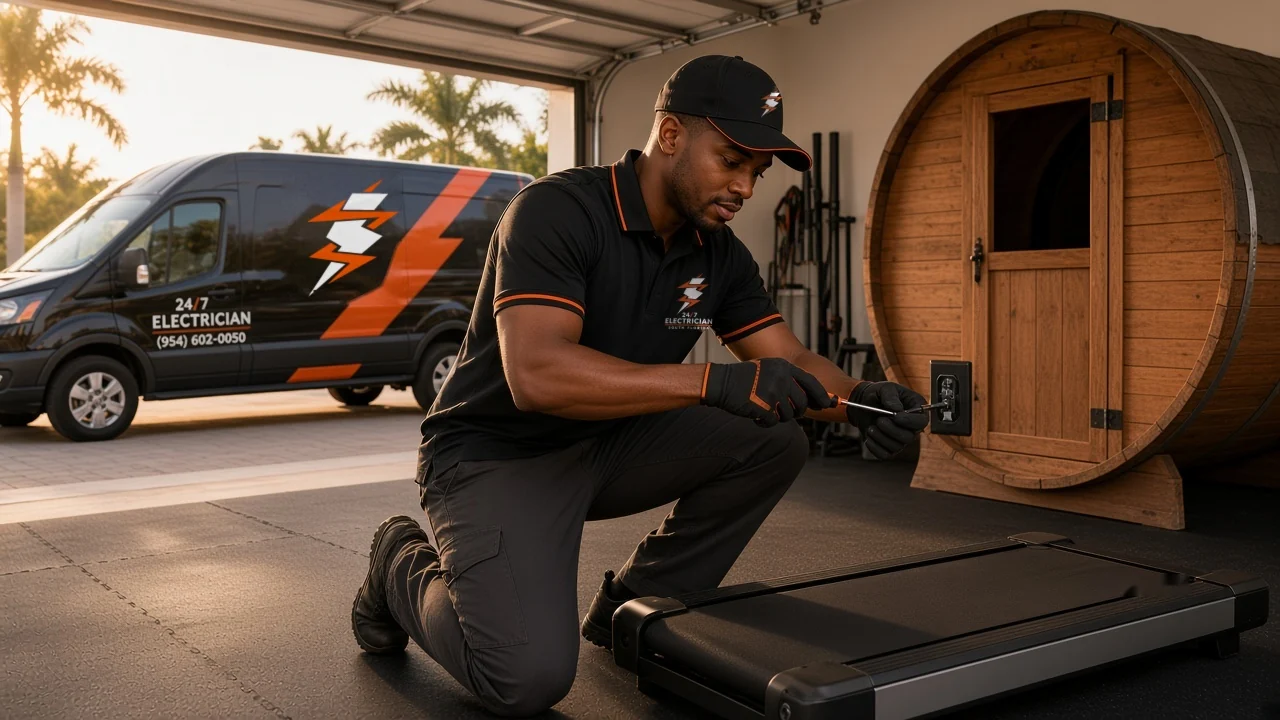
Home gyms have become a fixture in Pembroke Pines homes. The two car garage becomes a training space with a rack, a treadmill and a fan. A spare bedroom turns into a cardio room. A covered patio gets a cold plunge tub, and a barrel sauna shows up in the backyard.
The equipment is exciting. The electrical side is easy to overlook until a breaker trips in the middle of a run, a treadmill display flickers, or a sauna arrives with an installation manual calling for a circuit the house does not have.
This guide explains what common home gym equipment needs from your electrical system, how to tell whether your existing circuits can handle it, and when new circuits make sense. It is general guidance. Always follow the installation instructions for your specific equipment, and have a licensed electrician handle new circuits and anything involving water.
Why gym equipment is different from other household loads
Most household devices draw modest power or run briefly. Gym equipment can be different in a few ways:
- Motors under load. Treadmills, rowers with motors and some bikes use motors that draw more power when starting and when working hard, such as during an incline or a sprint.
- Long run times. A 45 minute workout means sustained draw on a circuit, often alongside fans and the garage refrigerator.
- Heat and water. Saunas use heaters that draw a lot of power. Cold plunges use chillers and pumps near water.
- Sensitive electronics. Consoles, screens and connected features do not like voltage dips and surges.
Put several of these on a circuit that was designed for garage lights and a couple of outlets, and problems follow.
Treadmills
Treadmills are the piece of equipment most likely to cause electrical trouble in a home gym.
What treadmill manuals often say
Many treadmill manufacturers recommend or require a dedicated circuit, meaning nothing else plugs into that circuit. Some specify the circuit size, the outlet type and whether to use surge protection. Some also give guidance about extension cords (usually: do not use one) and about GFCI protection.
Read your treadmill's manual before you buy or install it. The requirements vary by model, and following them protects both the equipment and its warranty.
Signs your treadmill needs its own circuit
- The breaker trips during incline changes or high speeds
- The console resets or flickers mid workout
- Lights on the same circuit dim when the belt starts
- The outlet or plug feels warm
GFCI and treadmills
GFCI protection is required in many locations, including garages and areas near water. Some treadmill manufacturers have notes about GFCI devices because motor controllers can cause nuisance tripping on certain models. That creates a real conflict between equipment instructions and code requirements. A licensed electrician can sort out the right solution for your treadmill and your space, rather than disabling a safety device.
Placement and cords
Where the treadmill sits matters as much as which circuit feeds it. Leave clear space behind the belt, keep cords and cables off the floor where a foot or the belt can catch them, and place the outlet where sweat and spilled water cannot reach it. If the outlet is not where the treadmill needs to be, ask an electrician to move or add one rather than reaching for an extension cord. A short, tidy run from a properly placed outlet is safer and easier to live with every day.
Saunas
Saunas have become popular in South Florida homes, whether a barrel sauna on the patio, an indoor cabin in a spare room, or an infrared unit in the garage.
Traditional saunas
Traditional saunas use electric heaters that warm stones and the air inside. These heaters often draw significant power and frequently require a 240 volt dedicated circuit, sized according to the heater's rating. Many also require a specific wire type rated for heat inside the sauna and a disconnect or controller placed according to the manufacturer's instructions.
Infrared saunas
Some smaller infrared saunas plug into a standard outlet, while larger units may need a dedicated circuit or 240 volts. Check the specifications before you buy.
Outdoor saunas
Outdoor saunas need a circuit run from the house to the sauna, with wiring rated and protected for outdoor or underground use, and equipment rated for wet locations. This often involves trenching or conduit along the house, and a permit.
Cold plunges and ice baths
Cold plunge tubs have gone from niche to common. They typically include a chiller to cool the water and a pump and filter to circulate it. Some include ozone or UV sanitation.
Because cold plunges combine electricity and water, safety is the top priority:
- GFCI protection is essential for equipment near water. Many cold plunge manufacturers specify GFCI protection and a dedicated circuit.
- Placement matters. Keep electrical connections away from splash zones, and follow minimum distance requirements.
- Outdoor installations need outlets and covers rated for wet locations, with weatherproof in use covers.
- No extension cords. A cold plunge should plug directly into a properly protected outlet.
Some units also recommend installing the chiller on its own circuit, separate from other gym loads.
Fans, lights and the garage environment
A Pembroke Pines garage in summer is hot. Fans are not optional for many home gyms, and they add load too.
- Ceiling fans rated for damp locations work well in garages. They need a properly supported box.
- High velocity floor fans plug into outlets and add to whatever circuit they share.
- Lighting affects how the space feels. Bright LED fixtures use little power and make a garage gym usable.
- Mini split air conditioning is a popular upgrade for garage gyms. A mini split needs its own dedicated circuit and a disconnect near the outdoor unit.
If you plan to cool the garage, plan the electrical work for the mini split along with the gym circuits.
Garage gym or spare bedroom gym?
Where you put the gym changes the electrical picture.
Garage gyms have more room and tolerate rubber floors, chalk and dropped weights. But garage circuits were often designed for a door opener, a light and a couple of outlets for tools. Garages also call for GFCI protection, get very hot in summer and are where many homes already run a second refrigerator or freezer. Plan on at least one new circuit for a garage gym with a treadmill.
Spare bedroom gyms stay cooler and are closer to the house's air conditioning. Bedroom circuits, though, often feed several rooms at once. A treadmill in a bedroom can share a circuit with the hallway lights and the next bedroom's outlets, which is where flickering and tripping come from. Bedrooms also usually need AFCI protection, and some motor driven equipment can be sensitive to it. An electrician can sort out the right setup.
Covered patios and lanais are popular for cold plunges and outdoor saunas. Everything there needs to be rated for wet or damp locations, with GFCI protection and in use covers on outlets.
Three example setups
To make this concrete, here are three typical levels of home gym and what they usually need electrically. Your equipment and home may differ, so use these as a starting point for a conversation with an electrician, not as a design.
A light setup: a bike or rower, a fan, a TV and some lights in a spare room. Often works on existing circuits, as long as the circuit is not already heavily loaded.
A mid level setup: a treadmill, a rack, fans, a TV and a garage refrigerator in the garage. Usually calls for a dedicated circuit for the treadmill, GFCI protection where required, and possibly a second circuit for fans and the refrigerator.
A full setup: treadmill, sauna, cold plunge, mini split and lighting. Usually means several new circuits including at least one 240 volt circuit, outdoor rated wiring for patio equipment, a load evaluation of the panel, and possibly a subpanel or service upgrade.
Other equipment to account for
- Rowers, bikes and ellipticals with motors, screens or resistance systems
- Massage guns and recovery devices charging on outlets
- TVs and sound systems on a wall
- A garage refrigerator for drinks and supplements
- Compressors or tools if the garage doubles as a workshop
None of these alone is likely to be a problem, but together on one circuit they add up.
Talk to an Electrician
We answer the phone fast
From panels and wiring to lighting, generators, EV chargers and three phase power, we cover South Florida homes and businesses, including emergency repairs. Share the problem and we map out the repair.
Call (954) 602-0050How to tell what your current circuits can handle
You do not need to be an electrician to get a rough idea of your setup.
- Find out which breaker controls your gym outlets. Turn off breakers one at a time and see what goes dark. Write it down.
- List everything on that circuit. Include lights, other outlets in the garage, the garage door opener and anything in adjacent rooms on the same breaker.
- Check the breaker size printed on the handle, often 15 or 20 amps for general circuits.
- Compare with your equipment. Look at the rating labels on your treadmill, fans and other gear.
If the list is long and includes a treadmill, a refrigerator and fans, you probably need at least one new dedicated circuit. An electrician can do a proper load calculation and make recommendations.
When the panel becomes the limit
Adding several new circuits, especially a 240 volt sauna circuit, raises a bigger question: does your panel have room and capacity?
- Physical space: Are there open slots in the panel for new breakers?
- Service capacity: Can your electrical service handle the added load along with your AC, water heater, dryer and range? Many homes now also have EV chargers, which add significant load.
- Panel condition: Older panels or panels with known issues may need attention before adding load.
Sometimes the answer is simply adding breakers. Sometimes it means a subpanel in the garage. Sometimes it means a service upgrade. An electrician can tell you which applies.
Planning a home gym the right way
If you are building a gym from scratch, a little planning up front saves rework.
- Decide on equipment first, at least the big pieces: treadmill, sauna, cold plunge, mini split.
- Collect the electrical requirements from each manual.
- Sketch the layout, showing where each piece goes.
- Have an electrician evaluate your panel and plan circuits.
- Place outlets where equipment will be, so no extension cords are needed.
- Pull permits for new circuits and outdoor work.
- Install surge protection to protect consoles and electronics.
Red light panels, steam showers and recovery gear
Recovery equipment is a growing part of home gyms, and some of it has its own electrical needs.
Red light and infrared therapy panels usually plug into standard outlets, but larger panels or several panels together can draw more than you might expect. Check the combined rating if you plan a full wall setup.
Steam showers use a steam generator, often installed in a nearby closet or vanity. Steam generators commonly need a dedicated circuit, sometimes at 240 volts, and they are installed near water, so the manufacturer's requirements and code requirements for wet areas both apply. This is a job for a licensed electrician working with your plumber.
Compression boots, massage chairs and hot tubs each add their own load. A hot tub is a much bigger electrical project than most recovery gear and needs a dedicated circuit with a disconnect.
Ice machines for ice baths, instead of a chiller, are another load to plan for if you go that route.
When you list your equipment for the electrician, include recovery gear, not just the main machines. It is easy to forget the small items, and together they can tip a circuit over its limit.
What an electrician will ask you
To plan home gym circuits, an electrician will usually want to know:
- every piece of equipment you have or plan to buy, with model numbers
- where each piece will go
- whether the garage or room is air conditioned, or will be
- what else already runs in that area (refrigerator, freezer, door opener, tools)
- your panel location and any recent electrical work
- whether you have or plan an EV charger, since it competes for panel capacity
Having this ready makes the visit faster and the plan more accurate.
Surge protection for gym electronics
Treadmills and smart equipment have circuit boards that can be damaged by power surges, which are common in South Florida during summer storms. Options include:
- Point of use surge protectors rated for the equipment, if the manufacturer allows
- Whole home surge protection installed at the panel, which helps protect everything connected to the house
Some treadmill manufacturers have specific guidance about surge protectors, so check your manual.
Townhomes and HOA communities
Many Pembroke Pines homes are in HOA communities, and plenty are townhomes with shared walls. That matters for a home gym in a few ways.
Outdoor saunas, cold plunges and mini split condensers may need HOA approval for placement and appearance. Ask before you buy, not after delivery. In townhomes, the panel may be small and the service size modest, which limits how much new load you can add without a bigger project. Noise and vibration from treadmills and dropped weights travel through shared walls, so placement is about neighbors as well as circuits.
Before storm season
Outdoor gym equipment needs a plan for summer storms. Cold plunges and saunas on a patio should be on circuits you can easily shut off, and their manuals usually explain what to do before severe weather. Unplug sensitive equipment during lightning if your manual recommends it, and consider whole home surge protection. After a storm or a flood, have any outdoor equipment that got wet checked before you turn it back on.
Safety basics for any home gym
- No extension cords for motorized equipment
- Keep cords out of walkways and away from moving parts
- GFCI protection near water and in garages
- Unplug equipment when not in use if children are around, or use safety keys
- Keep the area dry around treadmills and cold plunges
- Watch for warning signs: warm plugs, burning smells, flickering, tripping breakers
Common questions
Can I plug my treadmill into a regular garage outlet? Possibly, but many manufacturers recommend a dedicated circuit. If the outlet shares a circuit with other loads, trips and flickers are common. Check your manual and have the circuit evaluated.
Does a sauna always need 240 volts? Not always. Many traditional saunas do, while some smaller infrared units run on standard outlets. Check the specifications.
Is a cold plunge safe outdoors? It can be, with proper GFCI protection, wet location rated outlets and covers, and correct placement. Follow the manufacturer's instructions and have an electrician install the outlet.
Can I add a mini split to cool my garage gym? Yes, in many homes. It needs a dedicated circuit and a disconnect. Make sure your panel has capacity.
Do I need a permit? New circuits, outdoor wiring and panel work usually require permits. A licensed electrician handles that.
Train hard, not your breakers
A home gym should be about the workout, not resetting breakers. With the right circuits, protection and planning, your equipment runs safely and reliably.
24/7 Electrician helps Pembroke Pines homeowners plan and wire home gyms, saunas and garage spaces.
- See our sauna and steam room electrical service
- Read about dedicated circuits for appliances
- Learn about garage workshop 240 volt circuits
- Check where GFCI outlets are required
- Know the signs your panel needs an upgrade
- Serving Pembroke Pines
Call 24/7 Electrician at (954) 602-0050.
Request Service
Tell us what is happening and we will take it from there
Use this form to give the office the full picture in one step: what is happening, the property location, entry details and the time you need help. Whoever calls you back has read it first.
If the power is out or something smells like it is burning, do not type. Call (954) 602-0050. We answer the phone fast.
Where We Work
36 cities across three counties
Every city has its own page for planned work, and its own page for after hours. Please choose the name of your city, or tap Emergency for urgent dispatch.
Broward County
- Coconut CreekEmergency
- Cooper CityEmergency
- Coral SpringsEmergency
- Dania BeachEmergency
- DavieEmergency
- Deerfield BeachEmergency
- Fort LauderdaleEmergency
- Hallandale BeachEmergency
- Hillsboro BeachEmergency
- HollywoodEmergency
- Lauderdale-By-The-SeaEmergency
- Lauderdale LakesEmergency
- LauderhillEmergency
- Lighthouse PointEmergency
- MargateEmergency
- MiramarEmergency
- North LauderdaleEmergency
- Oakland ParkEmergency
- ParklandEmergency
- Pembroke ParkEmergency
- Pembroke PinesEmergency
- PlantationEmergency
- Pompano BeachEmergency
- Southwest RanchesEmergency
- SunriseEmergency
- TamaracEmergency
- West ParkEmergency
- WestonEmergency
- Wilton ManorsEmergency