
24/7 Electrician
Barn, Stable and Outbuilding Electrical on Davie Properties
How to plan power to a barn, stable or outbuilding on a Davie property: feeders, wet and dusty locations, GFCI, lighting, and why permits belong in the plan.
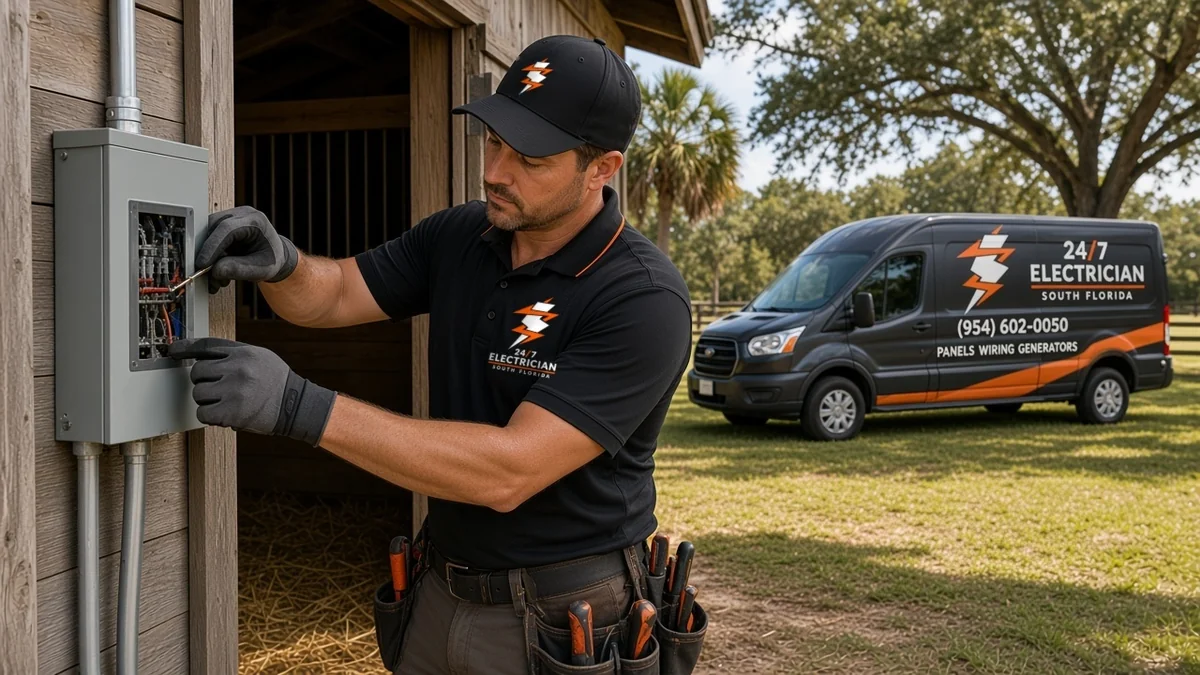
Davie still has properties that feel a little more open than a standard suburban lot: a barn or a stable from an earlier use, a workshop behind the house, a storage building, or a new outbuilding someone would like to light and power properly. Running a couple of extension cords from the house can feel like a solution for a weekend. It is not a plan for a building that will see damp floors, dust, animals, tools, or regular night use.
This guide is about planning power to a barn, a stable, or another outbuilding on a Davie property. It covers how power typically gets to the building, what wet and dusty locations ask of the wiring, GFCI and lighting, how to think about larger equipment, why pests and rodents matter, and why permits belong in the plan. It is general guidance, not a design for a specific building, and it is not a substitute for an on-site visit. 24/7 Electrician provides electrical wiring in Davie. Whether a feeder or a subpanel is right for your building is something to confirm on a visit, not something to assume from an article.
If you see sparks, a burning smell, or heat at a cord or an outlet, stop using it and treat it as urgent.
Running power to a barn
An outbuilding needs a planned path for electricity, not a chain of cords.
Start with how the building will be used. A storage shed with a light and one outlet is a different job from a workshop with tools, or a stable that needs lighting, receptacles, and equipment that may run for hours. The use decides how much power the building needs, and whether a small circuit from the house is enough or whether the building should have its own subpanel.
A feeder and a subpanel are the usual approach when the outbuilding will have several circuits. Power is brought from the house (or from another approved source) to a panel in the barn, and the barn's lights and outlets are organized there. That is cleaner to work on later, and it avoids overloading a single house circuit. It also has to be sized, protected, and installed correctly. Those details belong to the electrician and to the permit, not to a weekend guess.
The path of the run matters. Underground, overhead, or some combination, each has rules and practical issues: burial depth, protection of the cable, clearances, and how the run enters the building so water and pests do not follow it in. Do not trench a cable as if it were a garden hose.
The house panel has to be able to support the new load. A new outbuilding is not only a barn problem. It is also a house-panel problem. If the panel is already tight, or the service is small, that has to be part of the conversation before anyone pulls a feeder.
Temporary power is not a substitute. A construction cord or a long extension cord can be useful for a day's work. It is not a wiring method for a building you intend to keep using. If a cord is warm, damaged, or lying in wet grass, unplug it.
Our wiring page is the general service background. The visit itself is where we look at the house panel, the distance to the outbuilding, and the way you actually use the space.
Wet and dusty locations
Barns, stables, and many workshops are not like a bedroom. Floors get wet. Doors stay open in the rain. Dust, feed, and dirt get into places you would not expect. Electrical equipment has to be chosen and placed with that in mind.
A few practical points:
- Use equipment that is appropriate for the location. Outdoor-rated or otherwise suitably protected devices, covers that close, and entry points that keep water out are not cosmetic extras.
- Height and placement matter. An outlet at the height of a hose, a splash, or a kicking stall is a poor place for a receptacle. Lighting should be placed where it can be maintained, and where it will not be used as a hanging hook.
- Duct and cable routes should not be an open invitation to water. A hole in a wall or a slab, left loosely packed, will bring in rain and insects.
- A "it has been fine for years" cord along a damp floor is a delayed problem, not a design.
If the building already has wiring, a careful look can tell you whether it was installed as a real outbuilding circuit or as a series of add-ons. Old, exposed splices, missing covers, and rusty boxes are signs the work should be reviewed before you add more load.
GFCI and lighting
Two everyday features do a lot of work in an outbuilding: ground-fault protection, and lighting you can actually see by.
GFCI protection is a life-safety feature for many wet and outdoor locations, and for many outbuilding receptacles. It is meant to trip when there is a ground fault, which is how a person can be shocked. If a GFCI trips, treat it as information, not as a nuisance. Our guide on where GFCI outlets are required explains the idea in general terms. The exact requirements for your building are for the electrician and the inspector, not for a guess from a catalog.
Weatherproof covers on exterior and wash-down locations help keep water off the device. See our page on outdoor and weatherproof GFCI outlets. A cover that will not close because a plug is jammed in at an angle is not doing its job.
Lighting should be planned, not added last. A single bare bulb in the middle of a barn is a poor workplace and a poor place to find a tripped breaker at night. Think about:
- A switch at the entrance, so you are not walking through a dark building to find a pull chain
- Enough light in aisles, work areas, and at the panel
- Exterior lighting at the door, so the path from the house is visible
- Fixtures that can handle the location, and that can be reached for a lamp change without a dangerous climb
If you also want the building to be less of a target at night, lighting is part of that, together with a door that actually latches. Lighting is the electrical part. The lock is a different trade.
Fans, water heaters, pumps
Outbuildings collect equipment. A fan, a water heater, a small tool, or a pump can be a modest load or a serious one, depending on the nameplate.
Read the label on anything you plan to plug in or hard-wire. Voltage, amperage, and whether the device needs a dedicated circuit should guide the plan. Do not assume a general-purpose outlet can run a large motor or a heating appliance for hours.
Dedicated circuits are often the right answer for larger equipment, so a tool or a heater does not share a circuit with the lights. When the breaker trips, you do not want to lose the lights in a barn at the same time.
Extension cords are not a long-term plan for motors or heating equipment. They overheat, they get damaged, and they end up in wet or dusty places.
Pumps and similar equipment need a correctly protected circuit and a location that matches the environment. Specialized well or irrigation systems can have their own design needs, and those should be handled by someone who is actually doing that work. For a general outbuilding, tell the electrician what you want to run, and bring the nameplate information if you have it. Do not buy a large piece of equipment first and ask the wiring to catch up later, if you can avoid it.
If you already have a device that trips a breaker or warms a cord, stop using that setup and have it checked.
Rodents and wiring
Rodents like barns, feed rooms, and quiet attics. Wiring looks like nesting material, and chewed insulation is a common, ugly surprise.
A few habits help:
- Seal openings where a feeder or a cable enters the building, with materials meant for that job
- Keep storage off the wiring, and do not let feed or clutter hide the path of a cable
- If you find droppings, nests, or chewed cable, have the wiring inspected before you keep using the circuit
- A subpanel with a proper cover, and junction boxes with their covers on, is harder to nest in than an open splice
If damage is found, the repair is not "a little electrical tape." Damaged cable should be evaluated and, when needed, replaced. This is also a good moment to look at the rest of the run, not only the one chewed spot you can see.
Talk to an Electrician
We answer the phone fast
From panels and wiring to lighting, generators, EV chargers and three phase power, we cover South Florida homes and businesses, including emergency repairs. Share the problem and we map out the repair.
Call (954) 602-0050Permits
Electrical work to an outbuilding, a new feeder, or a new subpanel is the kind of project that often needs a permit and an inspection in Broward County. That is a feature, not a hassle. An inspector's look is one more chance to catch a problem before you depend on the building at night.
Our pages on Broward County electrical permits and why electrical projects involve permits explain the general idea. We can help coordinate the electrical permit when it is part of the job. The exact need depends on the work and on current local rules, so it should be confirmed for your project, not assumed from a neighbor's story.
A permit also protects you later, if you sell the property or if an insurance question comes up. Hidden, unpermitted work in a barn is a gift you should not give the next owner, or yourself.
Davie notes
Davie properties vary from compact lots to larger parcels with a real distance between the house and an outbuilding. That distance is one of the first things an electrician will want to know, because it affects the feeder, the voltage drop, and the path of the run.
A few local notes:
- After a heavy rain, low spots between the house and a barn can sit wet. The route of an underground run should respect that, rather than follow the shortest muddy line.
- Older barns sometimes have a mix of very old wiring and newer add-ons. Do not assume the last person's work was a complete system.
- HOA or community rules, where they exist, may affect the look of an overhead run or an exterior fixture. Check that alongside the electrical plan.
- If animals are present, say so. The work has to be scheduled and protected in a way that keeps people and animals safe while it is underway.
A photo of any existing panel, a photo of the path between the house and the building, and a rough idea of the distance will make the first phone call more useful. You do not need a measured drawing. You do need to describe the building honestly, including whether it already has a dirt floor, a wet corner, or a loft.
When you call 24/7 Electrician at (954) 602-0050, tell us you have a Davie outbuilding, what you want the building to power, and whether anything is already wired. A photo of the house panel and of the building's current lighting or outlets helps a first conversation.
What a careful visit usually includes
You should expect a walk of the house panel, the path to the outbuilding, and the building itself. Bring a short list of what you want to run, including nameplate information if you have it, and say what you might add in the next few years. A workshop that will only gain a welder or a compressor later should be discussed now, even if those tools are not on site yet.
A good visit also looks at access: how a person will reach the subpanel, how a fixture will be changed, and whether a disconnect is located in a sensible place. Equipment that cannot be reached safely will not be maintained, and equipment that is not maintained fails at a worse moment.
If existing wiring is present, ask for a plain-language summary of what can stay, what should be replaced, and what should not be used in the meantime. You do not need a lecture. You do need a clear picture before you spend money on fixtures or tools.
Frequently asked questions
Can you just add an outlet and a light without a subpanel?
Sometimes, if the use is small and the house can support it in a code-compliant way. If you expect tools, several circuits, or future additions, a feeder and a subpanel are often the cleaner plan. We will tell you what we see after a look at the property.
Are extension cords ever acceptable?
For a short, attended task, a cord that is rated for the job and kept out of water and traffic can be fine. For a building you use regularly, they are not a wiring method.
The barn already has power. Can you just add more?
We can look at what is there first. Adding load to a thin or informal setup is how breakers trip and wires overheat. Sometimes the first step is a repair or a proper feeder, not another outlet.
Do I need a permit for a light in a shed?
It depends on the work and on local rules. Ask, and let the project be described honestly. We would rather include a permit when it is needed than skip it.
Can I do some of the trenching myself?
Ask before you dig. Depth, path, warning tape, and the type of cable or conduit all matter, and there may be other utilities in the yard. Unplanned digging is a common way to create a new problem.
Can solar or a generator run the barn too?
They can be part of a larger plan, and they have to be designed as a system, not as a second afterthought cord. Mention them if they are already on the property or if you are thinking about them, so the outbuilding plan does not fight that work later.
What should I turn off before anyone arrives?
If something is already sparking, overheating, or smelling like hot plastic, stop using it and, if you can do so safely, shut off that circuit at the panel. Otherwise, leave the system as it is so the electrician can see how it is being used. Keep animals and children clear of the work area.
Planning power to a Davie barn or outbuilding?
Call 24/7 Electrician at (954) 602-0050. Tell us how you use the building, how far it sits from the house, and what you want to run. We will tell you what a proper plan would involve, including whether a permit is part of the job.
Related pages: Davie electrician, Electrical wiring, Broward County electrical permits, Why electrical projects involve permits, GFCI outlet requirements, Outdoor weatherproof GFCI outlets.
Request Service
Tell us what is happening and we will take it from there
Use this form to give the office the full picture in one step: what is happening, the property location, entry details and the time you need help. Whoever calls you back has read it first.
If the power is out or something smells like it is burning, do not type. Call (954) 602-0050. We answer the phone fast.
Where We Work
36 cities across three counties
Every city has its own page for planned work, and its own page for after hours. Please choose the name of your city, or tap Emergency for urgent dispatch.
Broward County
- Coconut CreekEmergency
- Cooper CityEmergency
- Coral SpringsEmergency
- Dania BeachEmergency
- DavieEmergency
- Deerfield BeachEmergency
- Fort LauderdaleEmergency
- Hallandale BeachEmergency
- Hillsboro BeachEmergency
- HollywoodEmergency
- Lauderdale-By-The-SeaEmergency
- Lauderdale LakesEmergency
- LauderhillEmergency
- Lighthouse PointEmergency
- MargateEmergency
- MiramarEmergency
- North LauderdaleEmergency
- Oakland ParkEmergency
- ParklandEmergency
- Pembroke ParkEmergency
- Pembroke PinesEmergency
- PlantationEmergency
- Pompano BeachEmergency
- Southwest RanchesEmergency
- SunriseEmergency
- TamaracEmergency
- West ParkEmergency
- WestonEmergency
- Wilton ManorsEmergency